Curriculum
Twenty-four detailed lessons
01. Write a watercolor project brief with testable limits
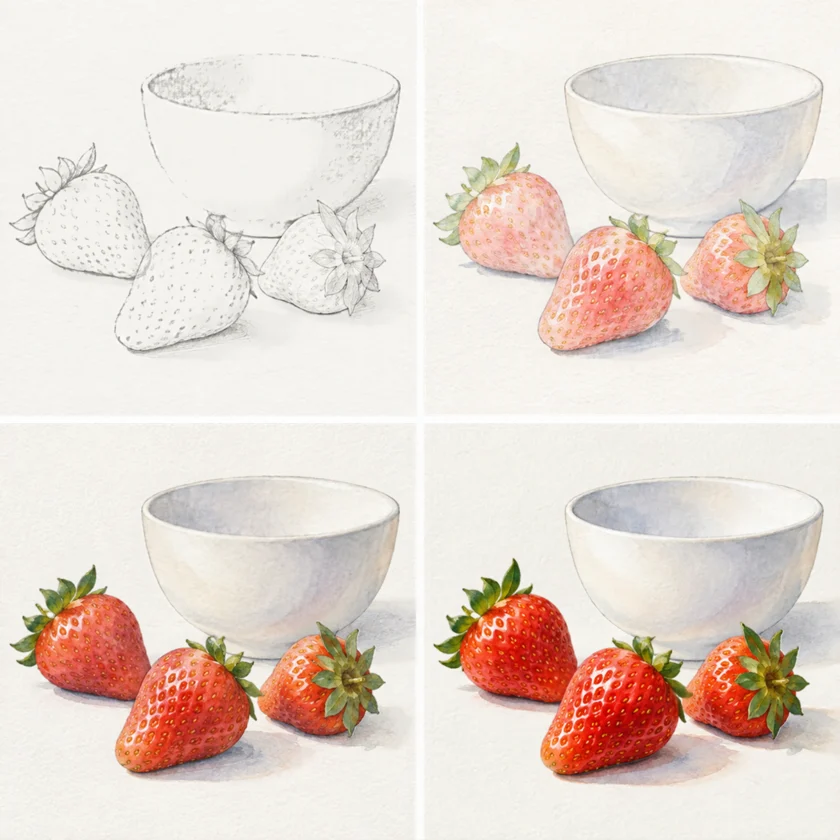
A project brief turns a subject into a manageable painting question. For strawberries and a white bowl, decide whether the priority is fresh transparent color, the overlap of fruit or the contrast between berries and ceramic. Limit the sheet size, palette and number of major washes. Plan the bowl's paper-white reserves before any red paint approaches them.
Practice: Complete two small strawberry studies using the same palette and different focal berries
02. Complete a fresh fruit watercolor from a planned sequence
A complete fruit watercolor needs a drying sequence as well as a drawing. Paint the palest areas before the deep berry notes, and let required boundaries dry. Strawberry seeds are finishing accents rather than the foundation of form. Keep them selective and consistent with the berries' turn rather than placing an even dotted pattern everywhere.
Practice: Complete two small strawberry studies using the same palette and different focal berries
03. Plan an acrylic project through color relationships
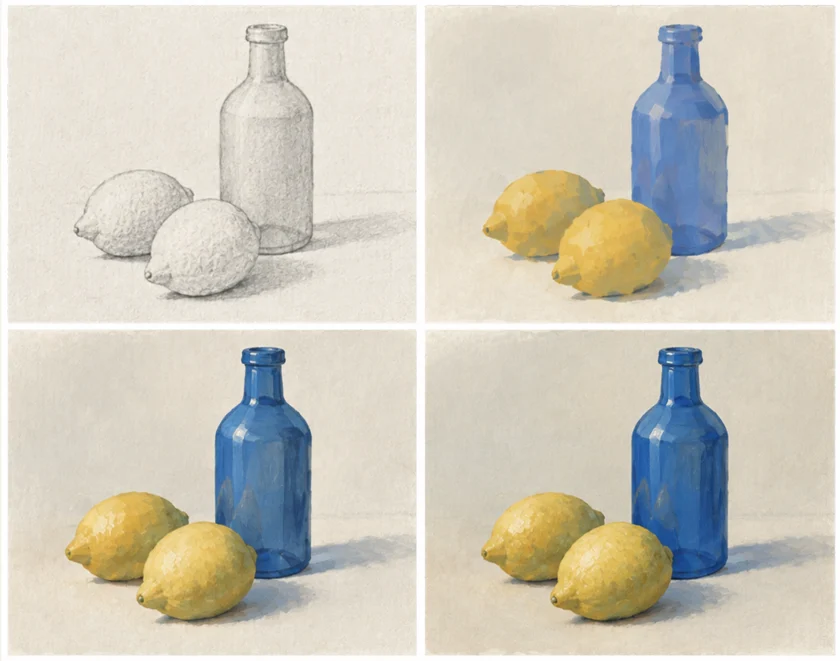
A bottle and two lemons offer a controlled relationship between cool transparent color and warm opaque-looking fruit. Choose the dominant shape and test the value relationships before painting. Keep the bottle axis, opening and base aligned. The lemons should vary in overlap and tilt rather than repeat as identical yellow ovals.
Practice: Paint a second version with the other lemon or bottle made focal through contrast
04. Resolve a still life without polishing every passage
Resolving the still life means deciding where enough information has been painted. The bottle may need a few selective reflection edges, while the lemons need a coherent light-to-shadow turn. Repainting every surface to the same smoothness can remove the original emphasis. Let unstable layers dry before making silhouette corrections.
Practice: Paint a second version with the other lemon or bottle made focal through contrast
05. Prepare a landscape wash and drying plan
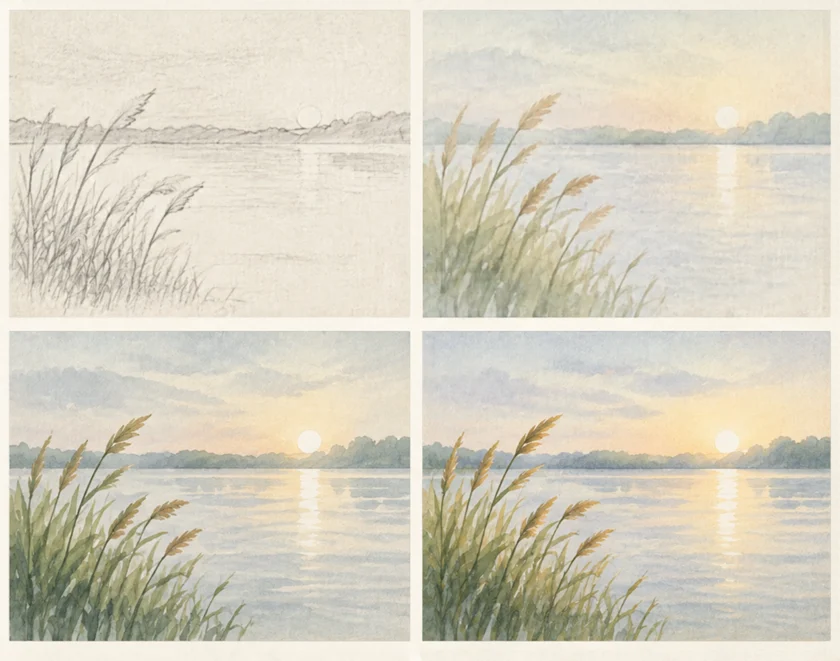
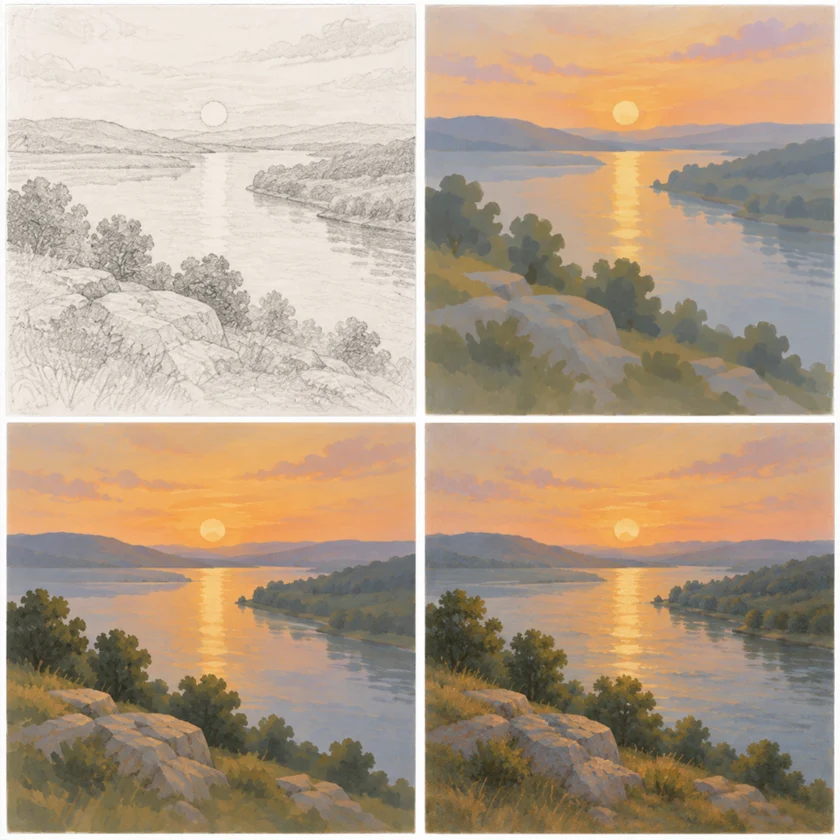
A sunrise landscape needs a wash plan that protects its main light. Choose the horizon, reserved glow and the broad reflection zone before wetting the sheet. Premix adequate pale colors and test how they meet. Do not rely on a generated sky to prove how particular pigments will blend; the matching-paper test is the practical evidence.
Practice: Paint three sunrise thumbnails with different widths of reserved reflection light
06. Finish a sunrise while preserving luminous paper
A finished sunrise can remain simple. Let the sky and water settle before adding land silhouettes and reeds where crisp edges are wanted. Reeds should form a few directional groups rather than a picket fence. Keep the strongest darks limited so the glow remains the painting's main event.
Practice: Paint three sunrise thumbnails with different widths of reserved reflection light
07. Translate a color sketch into an acrylic composition
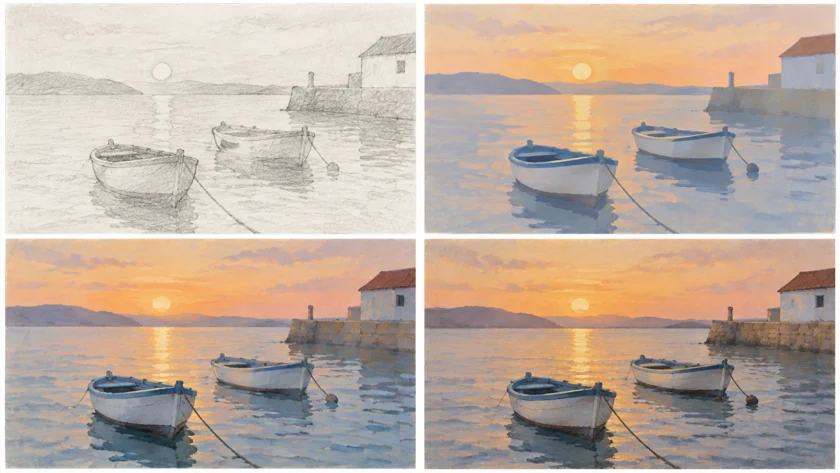
A color sketch is a decision tool rather than a miniature painting that must be enlarged mechanically. For a harbor sunset, establish the relation between warm sky, cooler water and the two boat silhouettes. Keep the boats large enough to construct plausibly but small enough to remain part of the whole. Use a prepared acrylic surface and test mixtures dry.
Practice: Paint the harbor twice with one boat made focal through different surrounding contrast
08. Integrate boats and reflections into a unified harbor
Boats and reflections belong to the harbor's value and movement design. Check the hull directions and support at the waterline before highlights. Reflections can be broken and quieter than their source, with their direction consistent with the intended water. A few opaque warm notes can suggest the sunset without covering the entire sea in orange stripes.
Practice: Paint the harbor twice with one boat made focal through different surrounding contrast
09. Plan a figure project around gesture and light
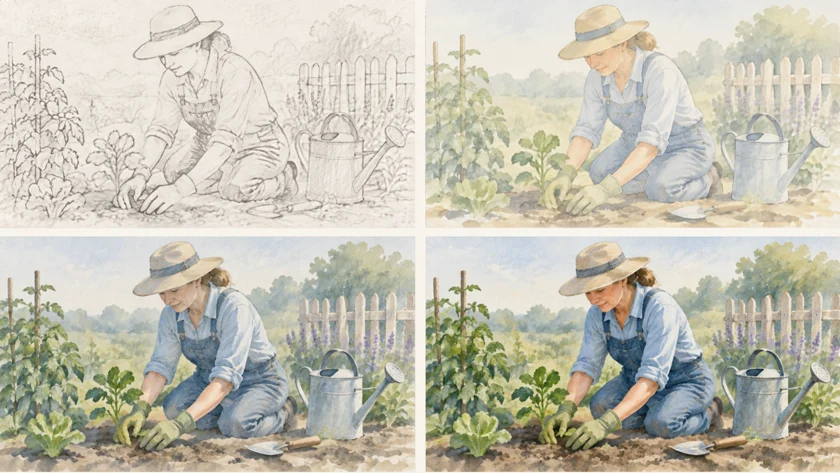
A gardener figure project should begin with the visible action and the main light shape. Decide whether the story is the person's bend, the hand-to-plant contact or the relationship to the garden bed. Keep the adult figure fully clothed and verify uncertain anatomy through a consenting sitter or suitable reference. Do not make facial detail the first task.
Practice: Paint three action thumbnails before completing one larger watercolor study
10. Complete a restrained watercolor figure environment
A restrained watercolor environment supports the action through grouped setting washes. Keep the figure-to-ground contact clear and let some less important boundaries merge. Hands can be simplified into plausible task groupings, but essential contact points must remain readable. Avoid a field of equally dark flowers around the figure.
Practice: Paint three action thumbnails before completing one larger watercolor study
11. Choose narrative through visible action and placement
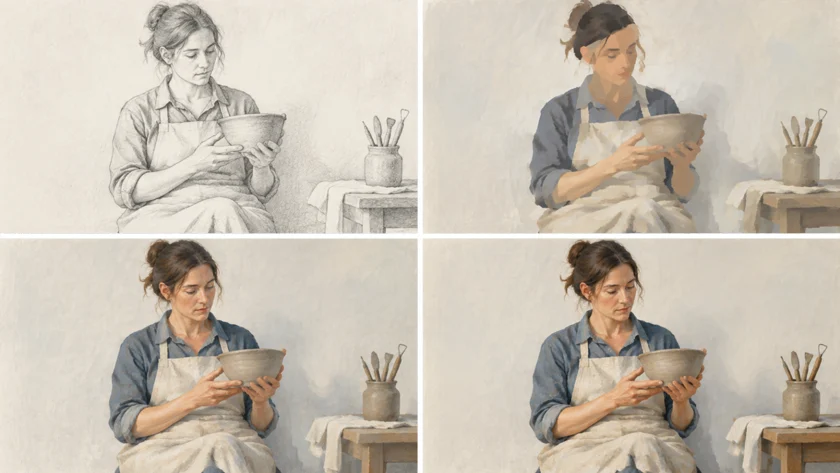
A working-person portrait is a composition about a person and a meaningful object. A potter with a finished bowl does not require a complex workshop full of tools. Relate the head, torso, arms and bowl through a clear arrangement. Keep the adult fully clothed and use plausible hands that support the bowl's weight and orientation.
Practice: Make a second thumbnail shifting emphasis from face to bowl through surrounding values
12. Finish an acrylic working-person portrait
Finishing the potter portrait requires checking person-object relationships before surface detail. The bowl ellipse and hands should agree about its tilt. Use opaque corrections on stable paint if a contact has drifted. Clothing folds and facial accents can stay selective so the painting's narrative remains clear.
Practice: Make a second thumbnail shifting emphasis from face to bowl through surrounding values
13. Plan an architecture project around negative shapes
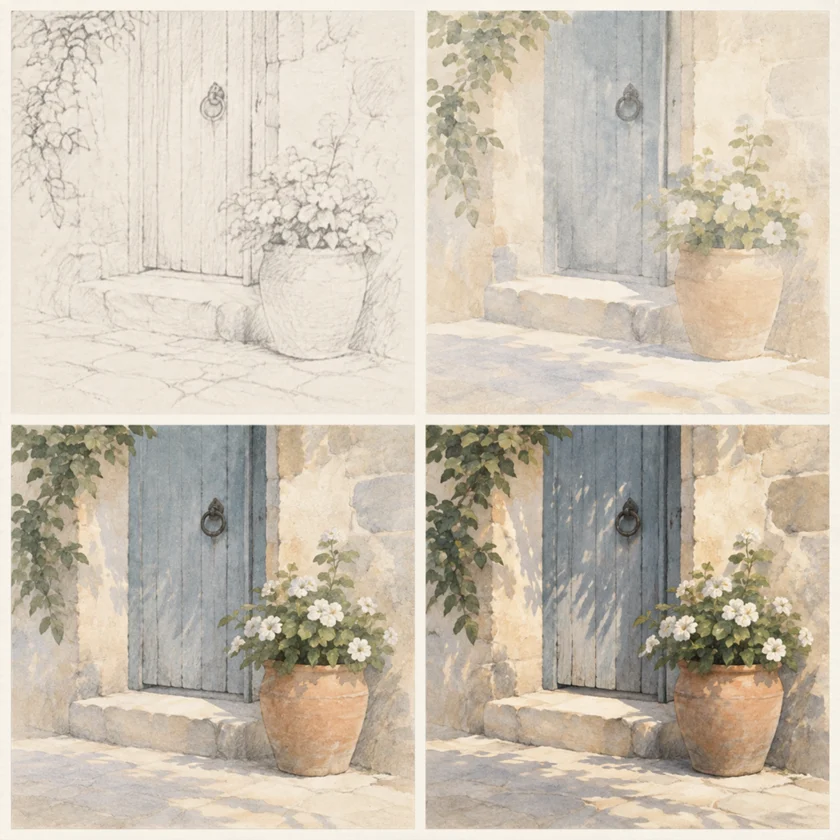
An old doorway can be designed through its negative opening, frame thickness and a few surrounding wall shapes. A flowering pot is a supporting shape rather than a requirement to paint every petal. Choose the main light-dark contrast before the first wash. Simplify inconsistent AI architecture instead of treating it as a construction drawing.
Practice: Paint two doorway studies using opposite light-dark opening designs
14. Finish a doorway watercolor with measured emphasis
Measured emphasis means giving the doorway enough structure while leaving surrounding texture subordinate. Paint the opening's depth after the wall wash dries where a crisp boundary is needed. Add a few flower and masonry accents near the focus. Avoid repeated dark chips across the whole wall.
Practice: Paint two doorway studies using opposite light-dark opening designs
15. Plan an acrylic atmosphere project through value
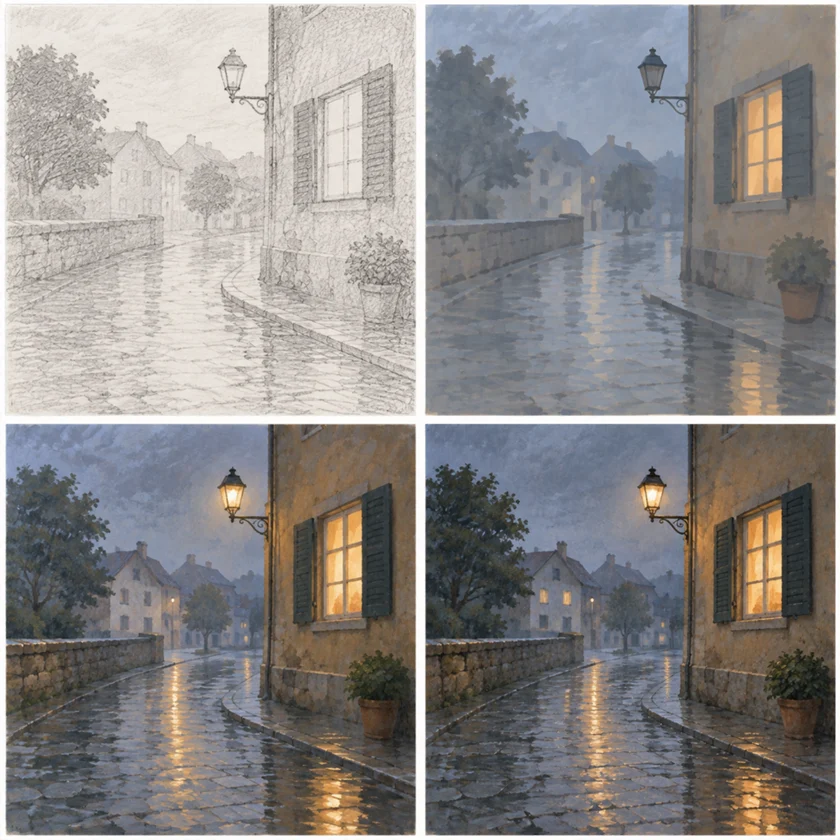
A rainy acrylic scene is a value design before it is a reflection exercise. Choose a simple window light surrounded by larger quieter darks. Draw the street plane and building edges so later wet reflections have a place to belong. The painting can suggest rain without depicting hundreds of individual drops.
Practice: Paint three reflection thumbnails with different amounts of uninterrupted dark street
16. Finish rainy reflections with controlled direction
Rainy reflections should follow the intended street plane and relate to actual light sources. Use broken directional marks rather than arbitrary colored streaks. Keep the window brighter and structurally clearer than most reflected passages. Opaque adjustments can recover a reflection that has become too strong once the underlayer is stable.
Practice: Paint three reflection thumbnails with different amounts of uninterrupted dark street
17. Use a restricted project to audit value skills
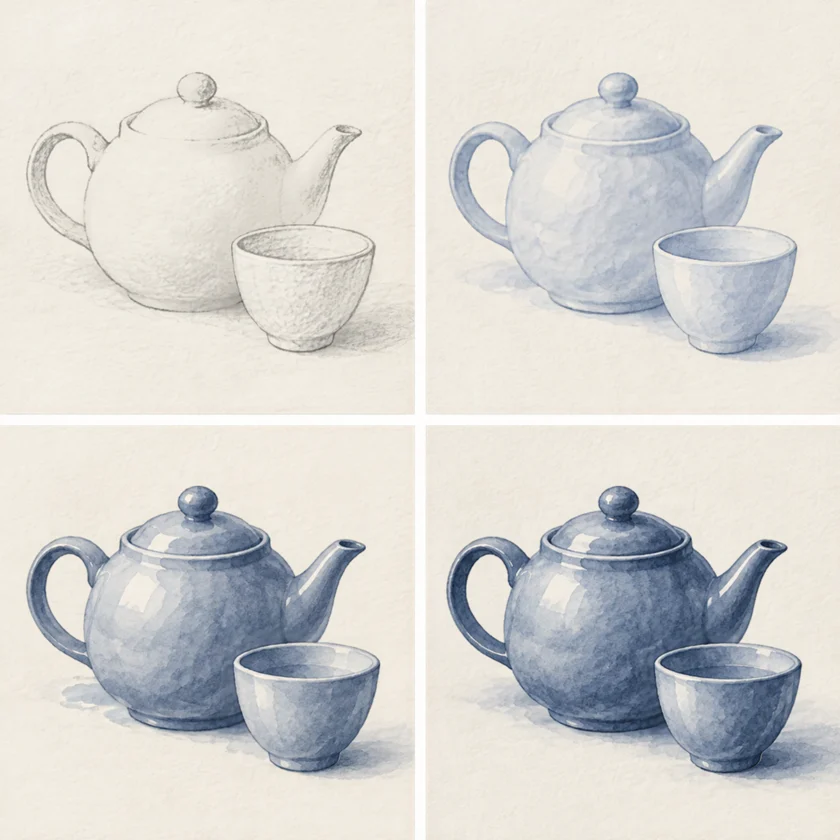
A monochrome project removes hue as an excuse for unclear values. Indigo is a possible choice, but its exact pigment composition and staining behavior vary by brand. Test the paint and use its actual label in your notes. The teapot and cup still need coherent ellipses, attachments and an overlap plan before wash effects.
Practice: Paint the same teapot arrangement in three values and then in five controlled values
18. Build a watercolor portfolio comparison
A portfolio comparison is useful when it shows a specific change rather than just a later date. Compare this monochrome study with an earlier still life using the same scale and neutral photographic light. Identify one improvement in value grouping and one remaining structural issue. Keep the original attempt instead of digitally repairing it for the comparison.
Practice: Paint the same teapot arrangement in three values and then in five controlled values
19. Use a restricted acrylic project to audit edge skills
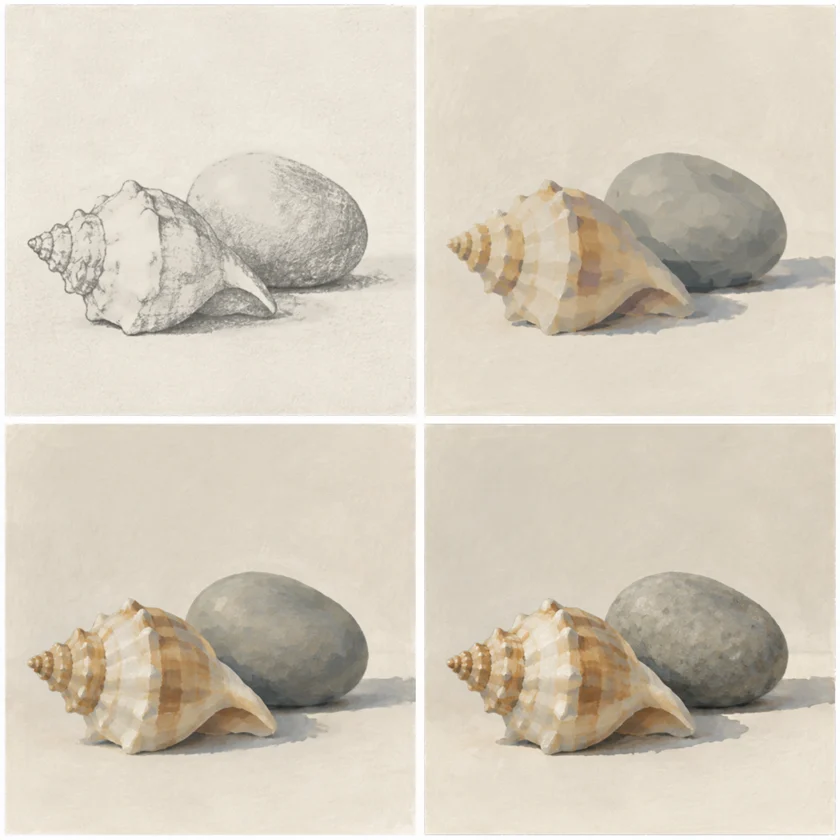
A restricted acrylic palette can reveal edge habits that a larger palette conceals. A shell and a smooth stone offer different surface structures within a modest arrangement. Choose colors for a usable value range rather than their names alone. The shell's ridges should grow from its larger form, while the stone can remain quieter.
Practice: Paint three small shell-and-stone studies with different focal edge placements
20. Build an acrylic portfolio comparison
An acrylic portfolio comparison should preserve evidence of actual handling. Compare a flat block-in photograph with the finished study and note which edges were changed on purpose. A smooth final surface is not automatically better than visible brushwork. Judge whether each edge supports the forms and the intended emphasis.
Practice: Paint three small shell-and-stone studies with different focal edge placements
21. Develop a coherent watercolor mini-series
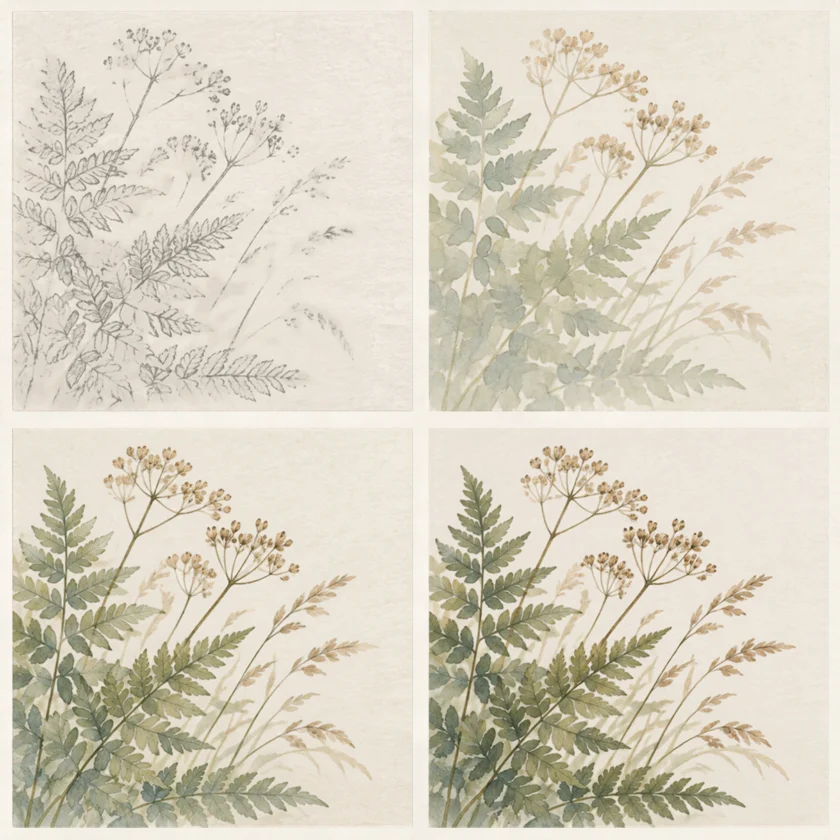
A mini-series needs a shared visual question and room for variation. Fern leaves and seed heads can share palette, sheet size and value range while changing arrangement. Plan three small studies instead of trying to make one overloaded botanical inventory. Record whether each source is observed, photographed or generated.
Practice: Document the same study in two lighting setups and choose the more faithful record
22. Photograph and record watercolor work honestly
Photographing watercolor honestly requires preserving the paper's appearance and the painting's actual color relationships. Use even neutral light, align the camera square to the sheet and avoid filters that deepen all colors. A simple crop and exposure correction can serve documentation, but disclose meaningful changes and keep the unedited record.
Practice: Document the same study in two lighting setups and choose the more faithful record
23. Develop a coherent acrylic mini-series
A coherent acrylic mini-series can use an abstracted landscape as a laboratory for shape, edge and color. Shared palette and size create continuity, while the hill, river and sky arrangements can vary. Abstraction does not remove the need for intentional value relationships. Write the series rule before painting the first panel.
Practice: Create a six-work practice portfolio with two concise evidence notes per work
24. Select a final portfolio and your next practice cycle
Selecting a final portfolio means choosing evidence of learning, not accumulating every page. Include a few studies that show different strengths and honest remaining questions. Keep watercolor and acrylic records clearly labeled. Use the series review to plan the next cycle around a specific gap such as moisture timing, opaque correction or focal-edge control.
Practice: Create a six-work practice portfolio with two concise evidence notes per work